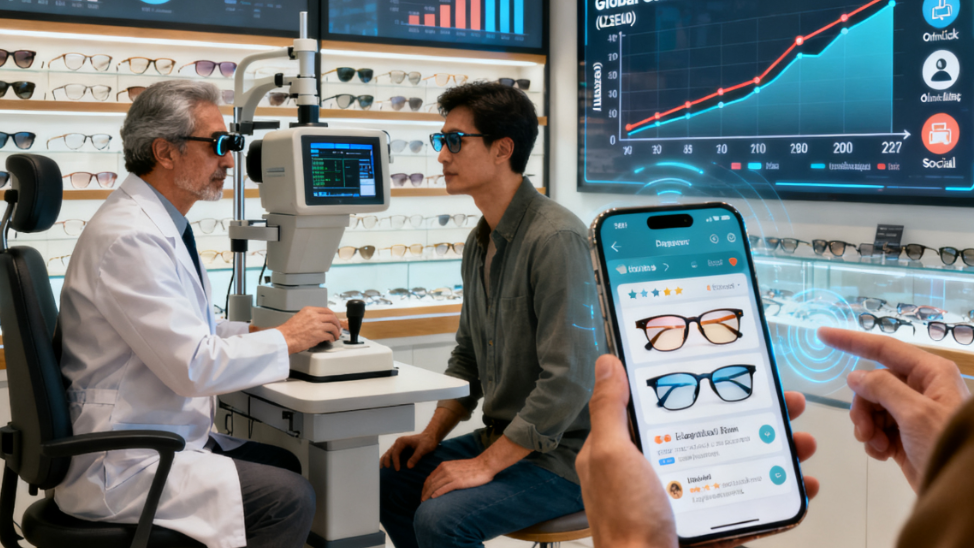
According to a report by Grand View Research of the United States, the total revenue of the global eyewear industry reached 200.4 billion US dollars in 2024. It is expected to increase to 221.8 billion US dollars in 2025 and is likely to reach 335.9 billion US dollars by 2030. The compound annual growth rate will be 8.6% from 2025 to 2030. Among them, optical glasses are the largest market segment, contributing over 69% of the industry's revenue in 2024. In terms of regions, Europe previously held a 36% share of the global market. However, in the next five years, the Asia-Pacific region is expected to become the fastest-growing market, with population growth, increased disposable income and a complete industrial chain as the main driving forces.
1.Tracing the sources of growth drivers
The rigid growth of health demands: Nowadays, people spend a significant amount of time using electronic screens whether for work or entertainment, and digital eye fatigue has become increasingly common. This has led to a continuous increase in the demand for functional optical glasses such as anti-blue light glasses. At the same time, the process of global population aging is accelerating, and the number of people with vision problems such as presbyopia is constantly increasing, further promoting the expansion of the core niche market of optical glasses. This is also the key reason why it can contribute over 69% of the industry's revenue.
The diversification and upgrading of consumption attributes: Glasses are no longer merely tools for vision correction but have also become important fashion accessories. Consumers are paying increasing attention to designer and custom-made frames. For instance, Ray-Ban's second-generation smart glasses, which were launched in collaboration with a metaverse company, have gained popularity among many consumers thanks to their fashionable appearance and intelligent interaction functions. The combination of this function and fashion has driven a dual growth in product premium and market size.
Technological innovation empowers industries: The functions of smart glasses are constantly upgrading, integrating AI voice assistants, health monitoring and other features. Lens technologies such as nano-coating, anti-blue light, and photochromism are also constantly being innovated, which not only enhance the practicality of glasses but also create new consumer demands. In addition, the combination of online shopping platforms and virtual try-on technology has improved consumers' purchasing experience and also promoted the overall revenue growth of the industry.
2.The evolution of regional market patterns
The European market remains at the top but its growth rate has slowed down: In 2024, Europe will become the core market of the global eyewear industry with a 36% market share. This is attributed to the local mature consumer market, people's strong awareness of eye health, and the demand for high-end and fashionable eyewear. However, the market in this region is approaching saturation and is likely to maintain a stable development trend in the future, with a growth rate that will lag behind that of the Asia-Pacific region.
The Asia-Pacific region becomes the core engine of growth: Population growth is a significant advantage for the Asia-Pacific market. In Southeast Asian countries like Indonesia and Vietnam, the young consumer group is constantly expanding. Meanwhile, the middle class in countries such as China and India has continued to expand, and residents' disposable income has increased, enabling consumers to purchase higher-quality eyewear products. In addition, the Asia-Pacific region is home to a large number of eyewear manufacturers and suppliers. The well-developed industrial chain can not only reduce production costs but also respond quickly to market demands. These factors jointly contribute to making the Asia-Pacific the fastest-growing market in the next five years.
3.Channel and competitive situation supplement
From the perspective of sales channels, offline stores will remain the mainstream in 2024, as consumers attach great importance to personalized optometry services and try-on experiences when getting their glasses fitted. However, online channels are rising rapidly. The development of technologies such as virtual try-on and online optometry consultation has made online spectacle fitting more convenient. In the future, the proportion of online channels is expected to increase further. In terms of competition, leading enterprises such as Essilor and Luxor have consolidated their advantages through a full industrial chain layout, while emerging brands have broken through in niche fields by leveraging customized and DTC (Direct-to-Consumer) models. Industry competition will become increasingly diversified.

 Slovenian
 Slovak
 Latvian
 Bosnian
 Icelandic
 Ukrainian
 Georgian
 Serbian
 Croatian
 Belarusian
 Romanian
 Estonian
 Hungarian
 Czech
Czech
 Catalan
 Norwegian
 Lithuanian
 Albanian
 Hindi
Hindi
 Italian
 Finnish
 Arabic
 Danish
 Bulgarian
 Thai
Thai
 Polish
 Swedish
 Greek
Greek
 Portuguese
 Dutch
Dutch
 Turkish
 Russian
 Deutsch
 French
 Korean
 Japanese
 English









Leave A Comment